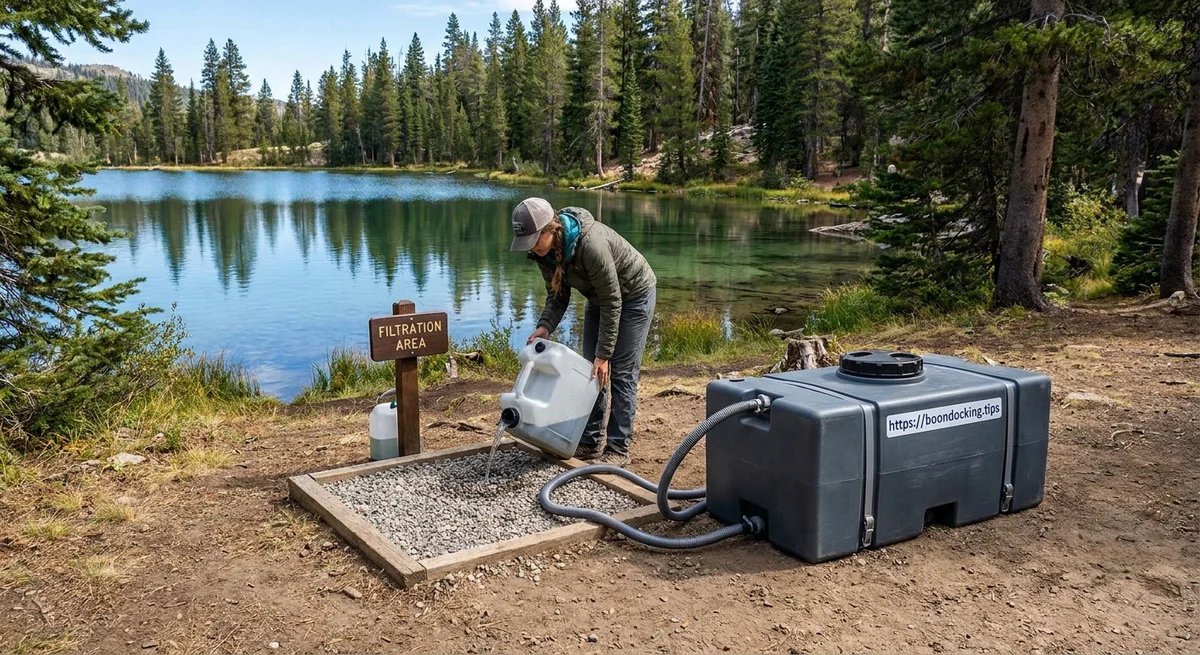
Greywater and Sewage Near Lakes: Eco-Safe Practices and Laws
Greywater & Sewage Management for Lakeside Boondocking
Lakeside boondockers must manage greywater (dish, shower, sink water) and blackwater (toilet waste) carefully to protect water quality and comply with laws. This guide compares toilet systems (composting, cassette, RV black tanks with/without urine diversion) and shows how they affect water use and waste volume. It then reviews legal requirements – such as minimum setback distances from lakes, soil absorption rules, and when to pack out or evaporate greywater – and offers low-impact dishwashing tips. We’ll debunk “biodegradable” soap myths and end with a checklist and decision map for wet and dry conditions.
Toilet Systems: Composting, Cassette & Black Tanks
Composting (Dry) Toilets: Modern composting or dry toilets (often waterless and odor-vented) use no flush water and separate solids and liquids. Because they require no water per flush, they generate essentially no blackwater or greywater from toilet use. Well-known examples (e.g. Nature’s Head, Separett) collect urine in a small container and hold solids in a composting chamber. This means minimal wastewater volume, plus high comfort and less frequent dumping (users only empty dry waste bucket periodically). In practice, composting units dramatically cut overall waste: only occasional hand-wipe rinse water or cleaning solution (if needed) enters the greywater stream. Urine-diverting composting toilets further reduce liquid: by channeling urine to its own container, they eliminate the need to flush with water altogether. (Note: urine is >90% water, so this cuts most liquid waste. The urine can be disposed on soil well away from water or diluted and dispersed on ground, if allowed.)
Portable (Cassette) Toilets: These small, self-contained toilets (also called chemical toilets) have a toilet bowl and a removable holding tank. They use some flush liquid (often pumped in) and may mix it with solid waste. They yield moderate grey/blackwater volumes. For a typical cassette unit, one flush might use ~0.5–2 gallons of water/chemical solution. The waste is stored in the cassette tank until you empty it at a dump station or toilet. Cassette toilets are more water-efficient than full-size RV tanks but still produce wastes that must be disposed properly. (Urine-diverting portable models exist; by separating urine into a smaller chamber, these can reduce flush frequency and volume, easing disposal.)
RV Blackwater Tanks: Traditional RV toilets use onboard holding tanks that collect all toilet contents plus the flush water. They produce the largest volume of sewage among these options. Each flush can use 1–3 gallons (or more) of freshwater, quickly filling the tank. This typically means frequent trips to dump stations. Blackwater tanks also carry sinks and shower drains (greywater) in many RVs, doubling the waste stream. In cold weather, blackwater tanks must be winterized or emptied to avoid freezing. Some RVers use urine-diverting retrofit inserts or dual-flush valves to cut waste: by diverting or reducing the liquid portion of waste, they shrink the tank volume and water use. In general, less water per flush (as in composting or diverting systems) means less greywater produced.
Legal Framework: Greywater & Sewage Disposal
Regulations vary by jurisdiction, but a few key rules apply in most U.S. public lands:
-
Federal Land Rules: National Park Service (NPS) regulations strictly forbid dumping any waste or “draining refuse” (including greywater) except at approved facilities (www.boondockersbible.com). NPS areas effectively require pack-out or use of facilities for both blackwater and greywater. The U.S. Forest Service likewise prohibits placing pollutants near water or leaving waste in unsanitary conditions (www.boondockersbible.com). Forest Service rules explicitly ban placing any substance near a stream or lake that may pollute it (www.boondockersbible.com). The Bureau of Land Management (BLM) is the notable exception: BLM allows dumping “wash water” (greywater) on undeveloped lands, as long as it’s not in developed campsites (ecfr.io). (“Wash water” is generally defined as water used for washing or cleaning. Wastewater from sinks, showers, etc., is technically allowed on BLM public lands if dispersed responsibly.)
-
Laws on Sewage: Regardless of location, discharging untreated sewage (human waste) into lakes or streams is illegal under federal Clean Water Act provisions. For example, U.S. boating laws prohibit dumping any untreated sewage within 3 miles offshore, including lakes, rivers or reservoirs (dbw.parks.ca.gov). Many states extend this: for instance, California forbids dumping any human waste into lakes or in harbors (dbw.parks.ca.gov). Practically, this means blackwater must be sealed until flushed at a proper dump station; it also underscores why greywater should stay out of water.
-
Setback Distances: Both federal advice and many state/local codes require keeping greywater and waste disposal well away from water bodies. The “safe” separation usually ranges from 50–100 feet up to 200 feet (60 meters) from shorelines. Leave No Trace (LNT) principles explicitly instruct campers to carry dish and body wash water at least 200 feet from streams, lakes, or campsites (lnt.org). A Canadian backcountry guide similarly advises scattering greywater in a broad arc 60+ meters from water sources (borealbase.ca). Some states codify distances: e.g., Colorado campground regulations require any pit toilet (latrine) be at least 50 feet from lakes or streams (regulations.justia.com). The goal is to ensure soil has room to filter and decompose contaminants before they reach water. In practice, whenever possible one should be well beyond the ridgeline or 100–200 foot buffer from any water body before dumping greywater on the ground.
-
Soil Absorption: Disposal methods depend on soil type. Sandy or gravelly soils with good drainage can absorb greywater and allow microbes to break down contaminants. Saturated, clay, or frozen soils cannot absorb water, so dumping overland will cause runoff or pooling. If the ground won’t soak it up, do not dump. In such cases – high water table, recent heavy rain, rocky ground or snow – the best solutions are to pack out greywater or use an evaporation method. The famous Burning Man festival (with very strict “leave no trace” rules) actually requires participants to pack out any greywater they create (burningman.org). For lake camping, this means if your site is swampy or the ground is brittle rock, you should collect wastewater in containers and empty it at a drainfield or toilet later. Some seasoned campers also carry collapsible tanks or dry-bed composters to hold greywater in uncertain conditions. In desert or alpine camps, one historic option has been to scatter greywater in a small hole to evaporate (the “sump method”), but modern ethics favor the scatter method on soil instead of a concentrated pit (borealbase.ca).
-
Pack-Out vs. Disposal: If local regulations or site conditions forbid on-site disposal, pack it out. Greywater can be carried out in empty jugs or buckets. As Burning Man advice notes, you can accumulate wash water and remove it from the site (burningman.org). (Household-style soaps should never go into containers you’ll reuse for drinking water.) In wilderness areas, packing out sewage (solid waste) is increasingly required; similarly, any heavy grease or soapy water may be better carried out or evaporated (e.g. by scattering on gravel or a large tarp in sun). In all cases, never dump greywater directly on a lakeshore or into a sinkhole.
Low-Impact Dishwashing & Soap Use
Minimizing the impact of wash water is crucial. Follow the classic Scrape, Strain, Scatter (or Evaporate) routine:
- Scrape: Remove all food scraps from dishes into the trash. This prevents attracting wildlife and concentrates nutrients in a handleable form.
- Strain: Pour wash water through a fine mesh or cloth to catch remaining solids. Dispose of these solids in your garbage (never in nature). A bandana or strainer works; many backcountry guides underline that “food particles attract wildlife” (borealbase.ca).
- Wash (minimal soap): Use up to three pots method: (1) wash, (2) rinse (boiling water if possible), (3) sanitize. Use hot water and scrubbing to remove grease first. Biological organisms often recommend not using soap at all unless needed. In fact, boiling water and scrubbing often cleans dishes well. If you must use soap (for heavy grease), use only a tiny amount of biodegradable soap with a bowl – and never spill any directly into nature. Wash water can be chlorinated (as in solar still bags) if needed for odor control on a pack-out camp. (Guidelines note that “dirty dishwater…contains food smells” so burying it helps attractivity over broad scattering (lnt.org).) Bars of castile or other “biodegradable” soaps still contain surfactants and nutrients, so the best practice is to minimize their use. (borealbase.ca) (lnt.org).
- Scatter / Evaporate: After washing, take the strained graywater at least 200 feet (≈60 m) from the lake/stream. Scatter it widely in a thin layer over a vegetated or downwind, absorbent spot. Swing the dishwater container in a broad arc so it soaks in over a wide area (borealbase.ca). Do not dump all your water in one spot — a puddle of sudsy water kills grass and fisheries, creates odors, and fails to soak in. If you’re in extremely arid or impermeable ground, you may need to help it evaporate: spread it on rocks or gravel in sun (in a sheltered place to avoid runoff) or dig a shallow pit to trap water and allow sun evaporation. In winter or freezing conditions, greywater will freeze quickly; still, scatter it away from ice so the spring thaw doesn’t wash contaminants into the lake (borealbase.ca).
Importantly, wash water should never be emptied into latrines or toilets. Toilets and vaults are for human waste only. Pouring dishwater or shampoo into a toilet can overload systems and increase odor. Instead, keep such greywater out of sanitation facilities.
Biodegradable Soap: Myth vs. Reality
The term “biodegradable” on soap labels is often misunderstood. Biodegradable simply means that, given time, microbes can break the product down. It does not mean “instantly harmless.” In outdoor conditions (cold water, low bacteria), even “green” soap can take weeks to decompose and its byproducts may be problematic. Many soaps contain nutrients (like phosphorus or nitrogen) that are precisely what aquatic ecosystems usually need to limit. For example, in New Hampshire, most soaps with phosphorus have been banned because the phosphorus causes algal blooms and oxygen depletion in lakes (blog.jackmtn.com). In practice, biodegradable soaps still harm aquatic life. As Leave No Trace warns, any soap in water can increase nitrogen and “actually cause significant harm to aquatic inhabitants” (lnt.org). Even “natural” soaps often don’t fully decompose before being washed into a lake. The LNT “Skinny on Soap” states: “Getting any soap in a water source is not acceptable… the soap can cause all sorts of issues from increased nitrogen to significant harm to aquatic life.” (lnt.org).
So: avoid washing in the lake/stream, even with biodegradable soap. Always wash well away from water and scatter the wastewater on land, as above. Remember: dilution is NOT a safe solution; dirty water should be treated as a pollutant unless you can broadcast it harmlessly on land far from water (blog.jackmtn.com) (blog.jackmtn.com). When in doubt, use the minimum amount of soap (or none) and follow the scatter guidelines.
Compliance Checklist & Disposal Decision Guide
On-Site Checklist:
- Know the rules: Identify who manages the land. If it’s BLM public land or designated backcountry where rules are lax, you may be allowed to scatter greywater (still following buffers). If it’s Forest Service or Park Service territory, assume dumping greywater is forbidden – you’ll need to pack it out or pre-dispose in approved facilities (www.boondockersbible.com) (www.boondockersbible.com). (When in doubt, contact the land manager or check posted rules.)
- Buffers: Always dispose of greywater at least 200 feet (≈60m) from any lake, stream, wetland or campsite (lnt.org) (borealbase.ca). Mark this distance before creating wastewater.
- Soil check: Ensure the ground is dry and absorbent. If the soil is saturated, frozen, or clayey, do NOT dump. Instead, plan to carry out or evaporate.
- Solid waste: Pack out all garbage and food scraps. Even “biodegradable” items should be buried only in a cathole; do not mix them with greywater. Never dump food scraps or fat outdoors (these attract animals and do not decompose quickly).
- Wastewater treatment: If you must use soap, choose a EPA-approved% waterproof container to hold greywater until disposal, or treat with chlorine before scattering (especially in high-use camps) to kill bacteria/odors.
- Emergency plan: If heavy rain or flooding occurs, greywater that you scattered may run off. In advance, be prepared to bail water into absorbent ground or carry it out in a secure jerrycan.
Disposal Decision Guide:
- Normal Ground (absorbent, dry conditions): Strain and scatter greywater on soil 200 ft from water. Bury minimal human waste in catholes at least 200 ft from water (lnt.org). Use portable toilet or pit depending on amenities.
- High Water Table / Saturated Soil: No dumping on or near soil. Either pack-out greywater in containers (portable tanks, jugs) or use evaporation: pour washed water onto vegetation or rock where sunlight and air can evaporate it safely, well away from water. Alternatively, wait for drier conditions or improve drainage (e.g. dig a deeper pit well offcamp) so waste can percolate safely. Reminder: some areas may require all waste packed out; follow local regulations exactly.
- Winter / Snow: Greywater will freeze near the surface. Choose a spot away from ice. You may need to save it in jugs (prevent freezing by adding a bit of bleach saltwater) or let it freeze on rocks for later pickup. Pack out any sanitized greywater solids.
- Using a Toilet in Sensitive Zones: If you use a toilet (vault or bucket), empty it only at designated dump stations. If required, pack out all solid waste in sealable bags (e.g. Hiker’s WAG bag) and bury or transfer at a latrine facility. Never throw toilet waste into lake or leave on surface.
- Post-Activity: Before leaving, inspect your site. Cover any waste holes and disperse any remaining greywater residue. Ensure you leave no visual or odor trace.
By following the “scrape, strain, scatter” method and planning for extreme conditions, campers can meet legal and ethical obligations. A quick compliance checklist:
- ⬜ Did I bring all appropriate containers (strainer, soap in hand, basin, jug)?
- ⬜ Do I know if this is BLM (wash water OK) vs Forest/NPS land (no dumping)?
- ⬜ Have I marked 200 ft from water as my washing zone?
- ⬜ Am I prepared to pack out waste if rain/snow/rocky soil prevents safe disposal?
- ⬜ Have I completely buried or removed any waste?
By combining the right toilet system (e.g. a waterless or urine-diverting toilet) with these low-impact practices and legal precautions, lakeside campers can boondock safely and compliantly without harming water resources.
Get New Boondocking Research & Podcast Episodes
Subscribe to receive new research updates and podcast episodes about boondocking, off-grid camping, RV travel, van life, dispersed camping, campsites, gear, power, water, safety, and road trip planning.