Multi-Week Lakeside Boondock Logistics: Resupply, Waste, and Water
Planning for an Extended Lakeside Camping Trip
A multi-week lakeside boondocking trip is a rewarding adventure, but it demands careful logistics. You must pre-plan water, waste, and energy needs along with resupply schedules to stay safe and Leave No Trace. This guide covers realistic consumption models for water (drinking vs. washing), waste, and power; suggests methods to ferry and store water; outlines eco-friendly sanitation practices; and provides planning tools like a sample timeline and resource calculator. With thoughtful preparation – including redundancy for critical systems – a 2–4 week off-grid camp can be both comfortable and environmentally responsible.
Water: Consumption, Transport & Storage
Water is life – especially off-grid. Plan for two categories: Potable (drinking and cooking) and Utility (washing, basic hygiene). A common guideline is approximately 1 gallon (3.8 L) per person per day for drinking, plus another 1 gallon for everything else (www.boondockersbible.com) (www.offgridrvhub.com). This means roughly 2 gallons (7.6 L) per person per day total. In disciplined, low-flow routines (short “Navy” showers, dish basins, etc.), two people can often manage with 5–8 gallons (~19–30 L) per day (www.offgridrvhub.com). On the other hand, a loose routine (streaming taps etc.) can double this.
For example, two campers for 4 weeks (28 days) at 2 gal/pers/day requires on the order of 224 gallons of water. A 100-gallon tank or bladder lasts ~4–5 weeks for two under conservative use (www.boondockersbible.com), so a plan might combine a fixed tank plus refill bladders or jugs. Always err on the safe side: assume extra water for hot/dry weather, cooking, or guests. Actionable step: Calculate per-person water needs (2 gal × people × days) and compare to your carry/storage capacity.
Transport and Storage Strategies
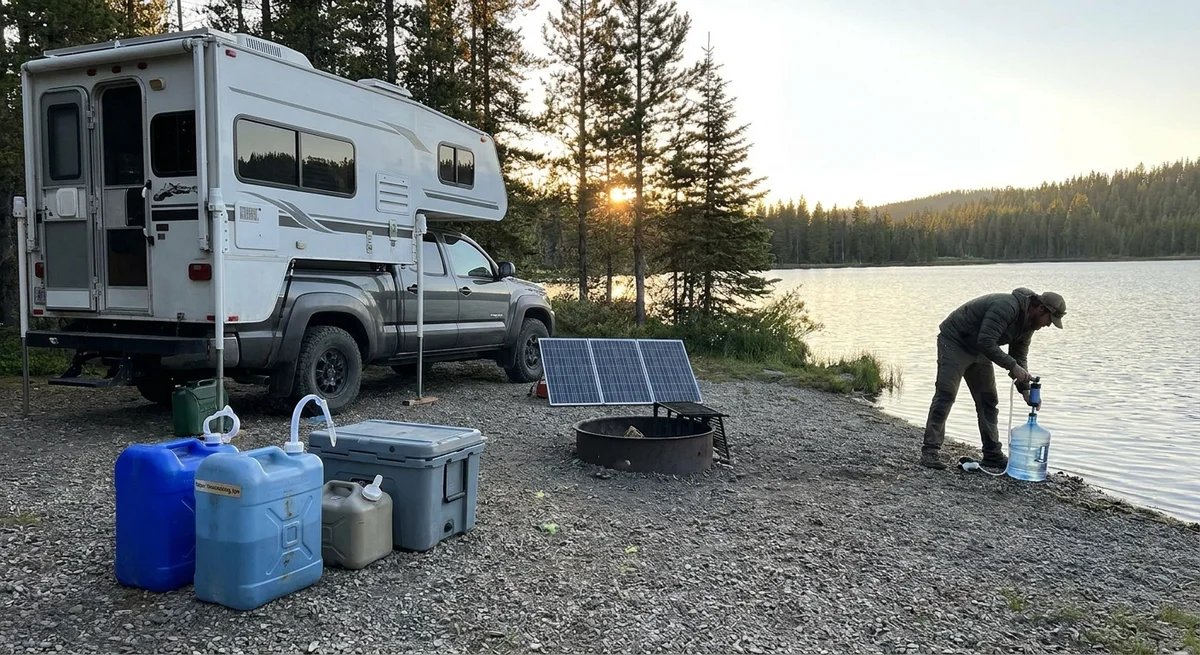
Hauling water to camp is a chore. Sturdy jerry cans or plastic jugs (e.g. 5-gal containers) are simple and stackable. A heavy 5-gal jug (~42 lb full) is best transported securely (in a truck bed or boat). For larger volume, use collapsible bladders or “tank bags” – flexible rubber bladders that unfold to hold 20, 50 or even 100+ gallons (www.boondockersbible.com). These fill via a garden-hose adapter or pump and collapse when empty. For lakeside sites, another trick is to ferry water by canoe/kayak if the shore is nearby: tie jugs inside a vessel and paddle ashore, or dip a bladder directly from the lake (filter before use).
If drinking water isn’t available on-site, be ready to trek to town or campsite showers periodically. Some campers drive to a boat ramp or general store every 3–7 days to refill jugs. Redundancy tip: have at least one refill plan. Eg. keep an empty bladder to take to town gardens/spigot, or carry extra capacity in jugs. Label your potable-water container so it never touches dishwater/greywater. (www.boondockersbible.com)
Treating On-Site Water
Never assume lake water is safe to drink without treatment. For potable needs, use filters, purification tablets, or boil lake water. (Always filter first if water is cloudy.) For utility water (dishes, cleaning), you can use lake water more freely – albeit with eco-friendly soap and scatter-disposal well away from the shoreline (see below). This practice stretches your stored freshwater by reserving it for cooking and drinking. Conservation tactic: cook one-pot meals to reduce washing, and wipe plates before rinsing to minimize dishwater. (www.offgridrvhub.com)
Waste and Sanitation Planning
Managing greywater (dish/shower water) and blackwater (toilet waste) is critical, especially by a lake. Follow Leave No Trace and legal rules: never dump any waste directly into a lake or within ~200 feet of it (boondocking.tips) (boondocking.tips). In practice, plan a daily routine that keeps soaps and effluent far from the shoreline.
-
Greywater (sink/shower): Always dump dish and shower water on land, not in the lake. Strain out food scraps and scatter the water in a broad, shallow arc onto vegetation (200+ ft from water) so soil microbes can filter it (boondocking.tips). Minimize soap use: use just a dab of biodegradable soap for greasy pans, or better yet, wash without soap by scouring with sand or ash when possible (boondocking.tips). Even “green” soaps can harm aquatic life if they run off. Do dishes over a basin and carry the water at least 70 m (200 ft) from shore before dispersing (boondocking.tips). Keep a bucket or collapsible bin for wash water if the ground is wet or you can pack it out later.
-
Graywater volume: If 2 people use ~8–10 gallons/day, expect ~10–20 gallons of greywater per week. Plan to dispose in stages (not all at once) to allow absorption. Consider a portable greywater tank if you must hold it for slow release. Never pour dishwater into a vault toilet (it overloads the system and entices pests) (boondocking.tips).
-
Blackwater (human waste): Use a portable camping toilet (cassette or cassette toilet) or a pack-out bag/toilet to minimize impact. If using a pit toilet (a dug latrine), dig it at least 200 ft from water on high ground, deposit waste, and cover with soil each time (about 6–8 inches deep) (boondocking.tips). Space multiple latrine sites around camp if many weeks pass in one spot, so nutrients don’t concentrate. If regulations allow, a pit privy can work; otherwise pack out solid waste in sealed bags.
-
Scheduling: Once or twice daily is typical for portable toilets (empty by afternoon, then thoroughly rinse/clean and re-seal). Carry toilet chemicals or sawdust for an RV cassette or camp toilet to reduce odor. If boiling water is available, rinse the unit with boiling water to disinfect before returning it to storage. Plan waste runs: if you have a cassette or chemical toilet, note local dump stations on maps. A weekly trip to dump toilets or refill supplies can align with other resupplies.
Eco-safety and local rules are paramount. Most parks forbid any sewage discharge into water (boondocking.tips). State laws often require 100–200 ft setbacks for disposal (boondocking.tips). Your schedule should explicitly avoid any water contact: for instance, wash in late afternoon when kids are off the beach, and burn all greywater (boil to sanitize) before scattering if near evening dew.
Energy and Power Use
Off-grid energy needs on a lakeshore camp are usually modest but critical: lights, recharging devices, and perhaps a small refrigerator. A typical minimalist off-grid setup uses around 1,000–2,000 watt-hours (1–2 kWh) per day (www.shop.solar). The largest drains tend to be refrigerators, communications equipment, and lighting (www.shop.solar) (www.shop.solar). For example, a 12V Camper fridge might use 400–700 Wh/day, and a laptop or phone charger only a few tens of watt-hours.
-
Power sources: Solar panels plus a battery bank are ideal for sunshine days. A single 100W panel in summer can yield ~300 Wh/day. Combine panels (e.g. 300–400W total) for backup power and charging. Always carry a backup generator (gas or propane) or an extra battery to cover cloudy days or unexpected loads. Small portable generators (2–3 kW) can run ~8–10 hours on a tank (8–10 liters gasoline) (www.fordgenset.com), so bring fuel if no convenient supply. Also consider a propane stove or firewood – cooking and heating with gas/wood saves electricity.
-
Energy budgeting: List critical devices (lights, fridge, headlamps, phones, etc.) and estimate usage. For instance, LED lights (~10W each) used 4 hours/day consume 40 Wh each. A mobile hotspot or Starlink adds ~500 Wh/day (www.shop.solar). Use Shop.Solar’s RV chart to tally appliances. Plan to recharge batteries daily (via solar or generator) or bring spare charged power packs for emergencies. Always have redundancies: spare solar cables, extra fuses, and a manual alternator charger if you have a vehicle.
-
Efficiency tips: Conserve power by using 12V lights, sleeping without power at night (headlamps or lanterns), and only running the fridge when needed. Limit high-draw devices (no AC on solar alone!). Monitor battery voltage regularly. Lower wattage devices (LED strip lights, low-power fans) extend autonomy.
Resupply, Caching, and Redundancy
No trip lasts longer than your supplies – so plan resupply stops and hidden caches.
-
Town runs: Identify the nearest small town or ranger station. For a 2–4 week trip, schedule at least one resupply stop (for fuel, ice, propane, food, or water). If you’re 10–20 miles from civilization, a weekly drive-out is reasonable. Stock up on bulk provisions (rice, beans, freeze-dried meals, etc.) and replenish perishables (bread, milk) mid-trip. Use a checklist (and store one copy in your rig and one separately) to track what's running low.
-
Caching supplies: If terrain permits, set up a hidden cache of essentials near camp before leaving: e.g., bury or stow some non-perishables or extra jugs in a concealed container (well above flood lines!). Water caches by the lake can supplement travel (e.g. a weighted container on a line). However, be cautious with caches to avoid animal interference and never hide food without rodent-proofing. More practical: stash an extra full water jug or fuel can in your vehicle in town, ready to ferry in.
-
Trash: Always pack out non-burnable trash. Bring sturdy trash bags, and plan to burn safe paper/wood waste in the fire (where allowed) to reduce volume. At minimum, plan collection runs every 7–10 days if garbage accumulates.
-
Redundancy for critical gear: Double-up on the most crucial items. For example: extra water containers (one jug leaks, another holds reserve), two flashlights per person, spare phone battery or solar charger. Keep a small tool kit and repair items (duct tape, rope, spare hose fittings) accessible. If your camp depends on any single device (like a pump or filter), carry a manual backup method (e.g. gravity-drip filter, or tablets if pump fails).
Timeline and Planning Tools
Example Schedule
Below is a sample 4-week timeline. Modify it to fit your situation and adjust for shorter trips by truncating. Mark key tasks like water resupply and waste disposal clearly in your personal calendar.
| Week / Days | Water Tasks | Waste & Hygiene | Energy & Equipment | Resupply & Notes |
|---|---|---|---|---|
| **Week 1 | ||||
| (Days 1–7)** | Fill fresh-water tank + jugs (e.g. 100+ gal) [*], set up bladders by tent. Test any filters. | Install stage-1 latrine spot >200ft from lake. Unpack portable toilet for first use (day 1 + day 3 cleaning). Set up dishwashing station well above high-water line. | Deploy solar panels & charge batteries. Inventory propane/cook fuel. Test all lights and chargers. | Stock initial groceries and ice. Stack 2 weeks of non-perishables. Check map for next town run (e.g. end of week). |
| **Week 2 | ||||
| (Days 8–14)** | Monitor water gauge daily, record consumption. Meetered water drips? If <day7 used ~X gal, adjust. | Rotate latrine holes if needed. Empty/clean toilet on Day 10 (pack waste for disposal at dump). Practice greywater scatter after dishwashing. | Check solar output. Possibly run generator mid-week to top off batteries and power any AC appliance briefly if needed. | Mid-week (Day 10): quick drive to town to dump waste, refill jugs, buy fresh veggies. Replenish propane if low. |
| **Week 3 | ||||
| (Days 15–21)** | On Day 15, fetch another supply by boat or drive (depending on access). Refill bladder before water runs low. | Freshen toilet holes or empty cassette on Day 17. Ration wash water: maybe take a Navy shower every other day. | Test backup gear (flashlights, radio batteries). Clean solar panels of dust. Avoid high-power draws; consider skipping fridge if too cold out. | If caches were set (e.g., extra water by shore), retrieve as needed. Plan final town run by end of week for last supplies. |
| **Week 4 | ||||
| (Days 22–28)** | Evaluate remaining water on Day 22. If below threshold, prioritize drinking uses or fetch more. Final refill at camp (scooping lake for dishes with filter!). | Last pit spot for waste. Ensure all used toilet chemicals and pack-out bags are sealed. Double-check that no waste remains. | Conserve battery: mainly 12V lighting. Pack spares of any spent consumables. | Day 24 or 25: one more trip off-site for gas, last ice/provisions. Prepare to break camp (pack gear, leave no trace). |
(*): capacity values will depend on your setup. For instance, two people using ~8 gal/day need 56 gal/week. A 100-gal bladder covers ~2 weeks at that rate (www.offgridrvhub.com).
Resource Calculator Example
Use this simple formula to size your supplies:
- Water:
(Daily potable per person + daily utility per person) × #people × #days. Example:(1 gal + 1 gal) × 2 ppl × 21 days = 84 gallonsneeded. If using 5-gal jugs, that is 17 jugs; or a 50-gal bladder plus 7 jugs. - Greywater tankage: anticipate rinsing ~5 gal/day of greywater per person; for 2 people, a 100-gal gray tank covers ~10 days (www.offgridrvhub.com). Plan to empty every few days by scattering water.
- Toilet capacity: A 5-gal cassette tank might fill in ~3–4 days for 2 people (assuming ~1.5 vs flush/guy/day). Carry extra empty jugs to remove off-grid if allowed. Alternatively, count how many portable toilet bags or days of soil burial you need (Plan for 1 dug latrine spot per 7–10 people-days).
- Energy: Total daily watt-hours = sum of (device watts × hours used). Compare with solar+generator output. E.g. Fridge (~500 Wh) + 4 LED lights (60 Wh total) + phones (20 Wh) ≈ 580 Wh/day. For 21 days, need ~12.2 kWh; with 200W solar (~1 kWh/day) and a 100Ah battery (1.2 kWh usable), bring at least 3–4 panels and 2–3 batteries as cushion, plus a 2–3 kW generator for cloudy days.
(These are examples; always customize to your gear and habits.)
Conclusion
Extended lakeside camping is hugely rewarding for the experienced outdoorsperson. By modeling your water and power needs, scheduling waste handling conscientiously, and planning regular resupply (or caches), you stay prepared for any length of trip. Key practices include: carrying both drinking and washing water, using boats or bladders to ferry it, scattering greywater in nature (never into the lake), and choosing appropriate toilet systems. Always build in redundancies – spare containers, back-up fuel, extra food – so one mishap doesn’t spoil the trip. With these strategies and a clear calendar/checklist in hand, your multi-week lakeside boondock can be self-sufficient and sustainable.
Get New Boondocking Research & Podcast Episodes
Subscribe to receive new research updates and podcast episodes about boondocking, off-grid camping, RV travel, van life, dispersed camping, campsites, gear, power, water, safety, and road trip planning.