Portable Showers and Water Heating from Lake Sources
Introduction
Taking hot showers and staying clean can be challenging when you rely on lake or stream water off-grid. Campers and overlanders have developed portable shower solutions that work without electricity or plumbing. Common options include black solar shower bags, water-warming coils on camp stoves, propane “instant” heaters, or simply boiling water in kettles and using a bucket. Each method has trade-offs in cost, speed, and convenience. In all cases, water from natural sources must be treated before use – drinking water absolutely, and even shower water to avoid skin infections and contaminants. In wilderness environments, it’s also critical to minimize graywater impact and follow sound hygiene routines for health in both warm and cold climates. Below we survey off-grid water-heating options (with their energy use), outline how to treat lake water for bathing vs. drinking, note the effects of chlorine on skin, and suggest low-impact hygiene practices for different conditions.
Off-Grid Water Heating Methods
Solar Shower Bags
A simple approach uses black plastic solar bags (often 10–20 L in size) that you fill with lake water and leave in the sun. The black material absorbs sunlight and heats the water. In good sun, a 15–20 L bag can reach lukewarm to hot temperatures (around 37–40 °C) by afternoon (intothecamp.com). Typical guidance is to fill the bag early in the day and lay it flat or hang it in full sun (rotating it if necessary) so it can heat evenly (intothecamp.com). There is no fuel cost – only adequate sun exposure and time (often 3–6 hours in summer sunlight) are needed. The downside is wait time and weather dependency: in cold or cloudy conditions the water may not get hot, and water capacity is limited by bag size. The flow is just gravity-fed, so water pressure is low, but these bags work well for quick 3–5 L showers.
Camp-Stove Heat-Exchanger Coils
Another free-heat approach uses your campfire or stove as a heat source. A copper coil immersed in hot coals or flame can heat water by convection. A DIY method is to coil a length of copper tubing and drop it through a fire with the ends sticking out. As heated water expands, it pushes itself back into a reservoir (the same tank or bucket you drew from) and draws fresh cold water into the coil, creating a self-circulating hot-water loop (www.4wdingaustralia.com). In practice, this delivers near-boiling water as long as the fire is hot and water is supplied. Because the “fuel” is just firewood or stove gas already being used for cooking, the extra cost is negligible – it simply leverages the heat already available. It does require care: the container must be vented so pressure does not build up (www.4wdingaustralia.com), and you must never let the coil run dry. This method can heat many liters very quickly (within minutes once the fire is up), essentially limited only by how much wood or stove fuel you have.
Propane On-Demand Heaters
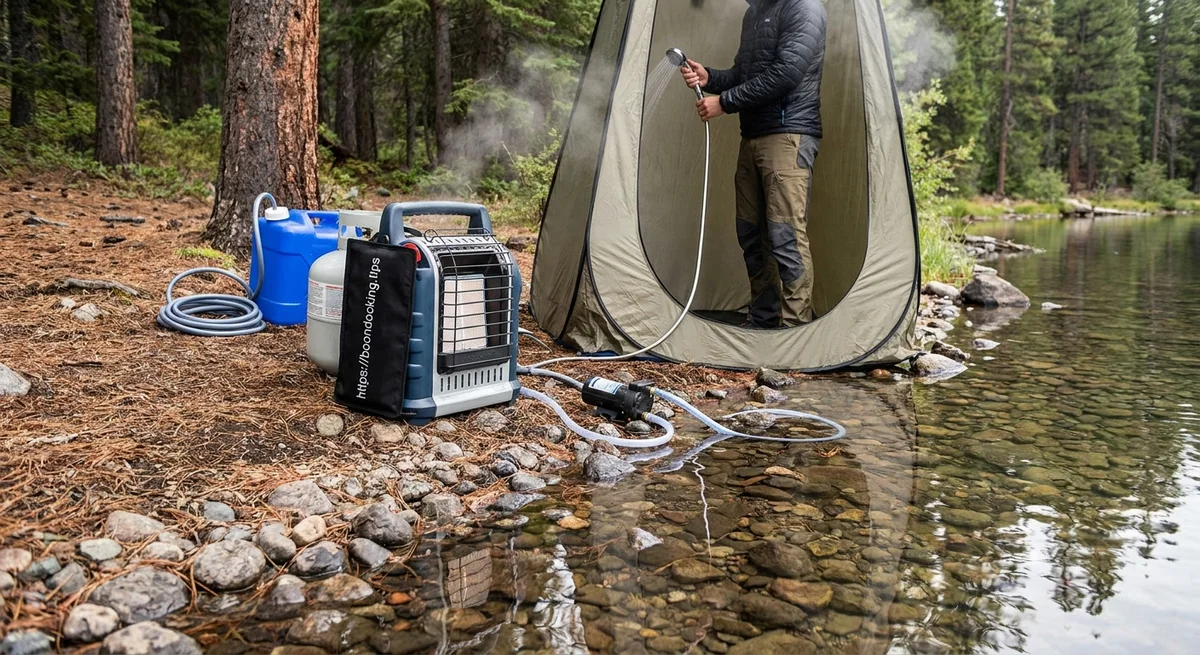
Portable tankless propane water heaters provide instant hot water and are popular with RVers, vanlifers, and campers. These burners mix cold water with propane flame to deliver a steady hot-water flow, similar to a home tankless heater but in a camp-friendly size. Typical units range from 40,000 to 100,000 BTU/hr (12–30 kW) and can heat several liters per minute. They often run off small camping (LPG) bottles. The advantage is speed and temperature control: you can have near-continuous 38–45 °C water on demand with a lever or flow sensor. The drawback is fuel use and safety. A rough estimate: heating 20 L from 15 to 40 °C needs ~0.6 kWh (≈2.1 MJ) of heat, which is only a few tenths of a kg of propane; thus a 5 kg propane cylinder could supply on the order of tens of showers. Propane heaters burn fuel fast when flow is high, so plan fuel accordingly. Ventilation is critical. All combustion makes carbon monoxide; these units must be used outside or under a well-ventilated shelter. In short, run them as you would a camp stove – never inside a closed tent (intothecamp.com). Many are rated for outdoor use only. Under those conditions, on-demand gas heaters are a reliable way to heat water quickly off-grid.
Kettle-and-Bucket Methods
The simplest method is old-fashioned: heat water in a kettle or pot on your stove or fire, then transfer it to a bucket or portable shower bag. For example, you can boil a few liters in a camping kettle and mix it with cold lake water in a basin, or use a hand-pump sprayer filled with warmed water (intothecamp.com). Boiling destroys all germs in the bucket water (useful if you also want to disinfect) (www.cdc.gov). It takes more active effort: one must carefully handle hot pots and pitch water. But it is very flexible in any weather. You can heat just a cup or two at a time or multiple pots. Using 1–2 L at a time, you can do a “bucket/sponge” shower: dip and wring a cloth in the warm water, wipe down your body section by section (face, arms, torso, legs) and then a final rinse with the remaining water (intothecamp.com). This uses minimal water (often <5 L total) and works well in cold or windy conditions, since you stay bundled and only expose a little skin briefly (intothecamp.com) (intothecamp.com). Energy-wise, heating a few liters on a stove is similar to the propane heater calculation: about 0.1–0.3 kWh per 10 L per 25 °C rise. If you have firewood or gas anyway for cooking, the cost is just the extra stove time. In summary, the kettle-and-wash approach is low-tech and flexible, good for cold weather or when water needs to be conserved.
Water Treatment: Bathing vs. Potable Needs
Even if you’re just showering, lake or river water should be treated, because natural water often carries microbes (bacteria, viruses, protozoa) that can infect eyes, wounds, or guts if swallowed accidentally. Drinking water requires the most rigorous treatment. The CDC emphasizes that boiling is the most reliable way to kill all pathogens (www.cdc.gov). If boiling is inconvenient, the next best approach is to filter clear water then disinfect it (www.cdc.gov) (www.cdc.gov). For filters, use an absolute‐pore filter (≤1 µm) to catch Giardia and Cryptosporidium; sub-0.3 µm filters also remove bacteria (www.cdc.gov). Chemical disinfectants (bleach, iodine, chlorine dioxide) will kill bacteria and viruses but may leave some parasites (chlorine and iodine do not reliably kill Cryptosporidium without long contact times). UV pens can also destroy microbes after filtration (www.cdc.gov).
For bathing water, the risk tolerance is slightly different: you usually won’t drink it, but you will have prolonged skin and eye contact. It is wise to at least filter out turbidity and debris. A simple microfilter (1–5 µm) or cloth will remove visible particles and most protozoa, which is often enough if you avoid getting water in your mouth. If you want additional safety, you could disinfect bath water similarly: for example, add a tiny dose of unscented household bleach (sodium hypochlorite) and let it sit 30 minutes, or use UV. However, chemical residuals deserve caution. Drinking-water chlorine levels (1–2 mg/L) are usually safe to swim in, but they can dry the skin and irritate eyes if left on. For that reason, swimmers are advised to shower with soap after leaving a chlorinated pool or hot tub (www.cdc.gov). In practice, if you chlorinate your shower water, plan to rinse thoroughly with clean water before drying off. Do not use scented soaps in the lake (even “biodegradable” soap can harm aquatic life); wash on land away from water sources and use as little soap as possible to minimize lather in graywater.
In summary: purify all drinking water (boil or filter+disinfect (www.cdc.gov) (www.cdc.gov)). For shower water, filtering or using clear spring water and optionally mild disinfection will reduce pathogens, but emphasize washing off any chemicals. Wet wipes can also substitute for some washing steps (particularly in cold weather) to avoid excess moisture.
Energy Costs and Efficiency
Each heating method has different energy/time costs:
-
Solar Bag – Energy source: Sunlight (no fuel cost). Time: Slow – typically several hours of strong sun are needed to heat 15–20 L by ~25–30 °C (intothecamp.com). For example, a 15 L bag in midday sun might reach 35–40 °C after 4–6 hours. There is no ongoing fuel or electricity expense, but you must wait and monitor. Efficiency depends on insolation and ambient temperature; on a cloudy day a solar bag may produce only tepid water.
-
Wood Stove/Fire Coil – Energy source: Wood (or gas) used for cooking. Time: Fast – as soon as the fire is hot, the coil heats water in minutes. Fuel cost equals any extra wood burned. In a campfire scenario, a handful of coals can heat multiple liters without needing to light a separate fire. Thermodynamically, the system is quite efficient since almost all heat contacts the coil. As one report noted, a makeshift coil setup works “really well” and provides hot water reliably with minimal expense (www.4wdingaustralia.com) (essentially “free” if you’re already cooking on the fire). Run-time is limited only by fire duration and water supply.
-
Propane Instant Heater – Energy source: LPG gas. Time: Very fast – almost instantaneous flow of hot water at controlled temperature. For example, a 60,000–100,000 BTU/hr (17–30 kW) unit can raise water several gallons per minute. Fuel-wise, raising 20 L by 25 °C requires only ~0.6 kWh (≈2.1 MJ), which is a few tenths of a pound of propane; so a 5 kg camping tank (≈270 MJ) could theoretically do hundreds of liters of heating in total. In practice, a brief 5–10-minute run might use only ~0.2–0.5 kg of propane. Thus fuel cost per shower is modest, but you must pack enough propane for multi-day trips. Always follow safety guidelines: operate outdoors or under a vented tarp, and never inside an enclosed tent (intothecamp.com).
-
Kettle/Bucket – Energy source: Wood or gas (for boiling water). Time: Moderate – heating a few liters to ~60–90 °C may take several minutes per liter on a stove or open flame. For example, heating 5 L by 50 °C requires ~0.58 MJ (≈0.16 kWh), so one stove burner could do it in 3–5 minutes. This method’s energy cost is roughly the same as if you boiled that water for drinking. In return you gain flexibility (anywhere, any time) and minimal equipment. Water usage can be steered low (<5 L per wash if done by sponge).
In all cases, minimize water use to reduce effort and greywater. A full solar bag or shower setup might allow a 5-minute shower using 10 L or more; contrast that with a bucket shower or pressurized pump where you intentionally use only 2–3 L. (Experienced campers often aim for 3–5 L three-minute showers to conserve resources.) A useful trick: after cooking, drink your “dirty” wash water – i.e. rinse pans with warm water and drink the nutrient-rich broth – which eliminates that greywater entirely (borealbase.ca).
Graywater Minimization and Disposal
Greywater (dish, laundry, and shower runoff) can pollute sites if dumped carelessly. To minimize it: use only the amount of water needed, strain out any solids (food bits, hair) and pack them out, then scatter the strained graywater in a broad, vegetated area at least 60 m from any natural water (borealbase.ca). Do not dump a concentrated puddle of soapy water in one spot; instead flick or dribble the water as you walk to distribute it. Use biodegradable soap sparingly – if the kids are playing in a lake, at most use mild soap on land, not directly in the water. In winter, greywater will freeze; scatter still, as spring melt can otherwise channel into streams. In group camps, centralize dishwashing in one designated “kitchen pit” to contain waste. By using minimal water for showers (sponge baths, bucket rinses or short solar showers) you also minimize the volume of greywater. For example, the “drink-out-of-the-pot” camp-kitchen trick recovers calories and yields zero greywater (borealbase.ca). Following Leave-No-Trace principles – burying any undrinkable water soakages, straining all scrap, and widely dispersing soapy rinse – keeps camps clean and minimizes impact.
Field Hygiene Routines
Good personal hygiene prevents illness on multi-day trips. Handwashing (or sanitizing) before meals and after toilet use is critical to avoid GI bugs (borealbase.ca). Likewise, cleaning body sweat and dirt prevents skin infections and chafing. Below are practical routines:
-
Warm Climates: In hot weather or at beaches, plan for daily full-body cleans. Ideally, arrive at camp early enough to squeeze in a shower or soak. Use the “top-down” washing order: start with face, then neck and arms, moving downward (so soap and contaminants don’t drop onto already-clean areas) (www.mountaineers.org). Dry your feet first after arriving – moist feet breed blisters and fungus (www.mountaineers.org). Hang dry fabrics or wear sandals around camp to air them. Change into a fresh base layer at night. Experiments find that after the first 1–2 days of full wash-ups, many hikers switch to “targeted wipe-downs” each evening – focusing on face, armpits, groin and feet – especially when water is scarce (intothecamp.com). Always let sweat and soap rinse off onto soil at least 200 ft from any water.
-
Cold Climates: In cold or alpine conditions, avoid long exposure when bathing. Use a sheltered spot (or an enclosed shower tent) and warm water. The bucket/sponge method works best: heat a couple liters, dip a cloth and quickly wipe down critical areas (face, armpits, groin, feet) (intothecamp.com). A full stand-in-shower can chill you – so the Mountaineers advise short wipe-downs and immediate redressing in dry clothes (intothecamp.com) (www.mountaineers.org). Lay out your warm layers ahead of time so you can dress right after. Keep feet dry: wash and completely dry them nightly, then apply foot powder and change into clean socks or camp shoes (www.mountaineers.org) (www.mountaineers.org). In both cold and warm weather, changing into dry sleepwear (clean socks and underwear) each night is a must – you grow odor-causing bacteria if you sleep in the same sweaty garments (www.mountaineers.org). If a full shower is impossible, even rehydrated unscented wet-wipes in the vestibule or tent will freshen your face and body before bed (www.mountaineers.org).
In all climates: wash hands often, keep fingernails short, and treat any cuts promptly. Use unscented biodegradable soap only when needed (more for greasy spots than every wash), and avoid colored or perfumed products that might attract wildlife or linger in skin. Brush teeth after meals and before bed. By combining thorough first-day washes with quick nightly clean-ups (especially of high-odor areas), you can stay sanitary without carrying gallons of water. As one field guide summarizes: enter camp, dry your feet and change socks first, then wipe your way down the body from head to toe; finish in fresh dry clothes (www.mountaineers.org) (www.mountaineers.org).
Conclusion
Portable hot showers off-grid are entirely feasible with a bit of preparation and the right technique. Solar shower bags are lightweight and free once set in the sun. Campfire coils and stove-end bucket showers turn existing cooking fuel into hot water on-demand (www.4wdingaustralia.com) (intothecamp.com). Propane tankless heaters give luxury instant heat at the cost of LPG fuel. In all cases, filter or purify water first – absolute safety for drinking, and good practice for bathing. Be mindful of chlorine and soaps: disinfect potable water as recommended by CDC (www.cdc.gov), but rinse off chemicals on the skin (CDC even advises showering after a chlorinated swim (www.cdc.gov)). Minimize water use and graywater by using efficient techniques (short showers, wet-wipes) and dispersing wastewaters over ground (borealbase.ca). Finally, establish a routine: daily or nightly personal cleaning prevents illness. Change into clean, dry base layers each night and focus on feet, face, underarms, and groin – the areas prone to odor and infection. With these methods, you can stay clean and safe even far from plumbing.
Get New Boondocking Research & Podcast Episodes
Subscribe to receive new research updates and podcast episodes about boondocking, off-grid camping, RV travel, van life, dispersed camping, campsites, gear, power, water, safety, and road trip planning.